Do you get those Twin Cities Values packs from the StarTribune? First of all, they don't fit in the box and they definitely don't promote green businesses! If you flip to the back by your address you can see directions to be removed from their list. I am taking our address off right now....
Also, we just received a coupon pack from Red Plum. If you get those and no longer want to, click here. Goodbye junk mail!
Tuesday, August 31, 2010


More on Green Traveling (and Green Driving in General)
In the week and a half that Guthrie and I posted about Green Travel, we have actually learned a ton more that I wanted to share with everyone. Most of these refer to traveling by car and are from or inspired by The Green Year by Jodi Helmer, a cute little book from my grandma.
For the first time Guthrie and I used a GPS. Though not very useful in Minneapolis where 99.9% of the time we know where we are going and it's gridded, taking out much of the guess work, it would have been helpful in Atlanta! On trips, it's quite helpful because it saves buying maps and printing off directions. If you must look up directions (and this is anytime), have the directions sent to your phone or at least write it on a scrap piece of paper and recycle or compost it afterwards.
More on packing light - in cars, 100 pounds of cargo decrease fuel efficiency by 2 percent. It can add up quickly if you travel a lot! If you currently store things in your car -- take it out! You only need the essentials: car emergency kit and some winter clothing items if you drive in Minnesota in the winter months. Those golf clubs? They should be stored in the garage.
If you are gone more than a couple of days, contact the post office and stop the mail. Transporting excess mail that won't be read for a while and can just wait will save the post office on fuel costs.
Keep an eye on your Tachometer (you know, the thing with the RPMs we rarely look at). Keeping the car revving lower than 3,000 rpms will not only save on gas, but is more gentle on the engine, extending the life of your car.
A/C v. Windows? This book says that you improve fuel economy by 20 percent or more if you drive with the A/C on and the windows up, though this is on the highway, which is where you mostly are on road trips. In the city, most of our driving is within an hour of home and not on the highway. Put those windows down says treehugger.com.
One for air travel -- invest in a luggage tag and keep it in your luggage always. Using those small plastic/paper tags at the airport every trip is just waste. They rip and really only last one trip.
Hotel stay - whether or not you can stay in a green hotel, leave a comment card at the end of your stay highlighting what the hotel did well and what kinds of things they could improve upon. If the hotel does not already have a sign saying that they will, leave a not telling them not to change the sheets or new towels unless they are put on the floor.
Update on our trip -- sadly we had to cancel our trip to Iowa for Labor Day weekend, but instead we are heading up to Duluth to visit Guthrie's family and to fish. When we do visit IA, we will be able to stay with a friend to help keep our carbon footprint down since it was not looking good for mother earth as of the last post.
Have a safe and fun labor day!
Peace!
For the first time Guthrie and I used a GPS. Though not very useful in Minneapolis where 99.9% of the time we know where we are going and it's gridded, taking out much of the guess work, it would have been helpful in Atlanta! On trips, it's quite helpful because it saves buying maps and printing off directions. If you must look up directions (and this is anytime), have the directions sent to your phone or at least write it on a scrap piece of paper and recycle or compost it afterwards.
More on packing light - in cars, 100 pounds of cargo decrease fuel efficiency by 2 percent. It can add up quickly if you travel a lot! If you currently store things in your car -- take it out! You only need the essentials: car emergency kit and some winter clothing items if you drive in Minnesota in the winter months. Those golf clubs? They should be stored in the garage.
If you are gone more than a couple of days, contact the post office and stop the mail. Transporting excess mail that won't be read for a while and can just wait will save the post office on fuel costs.
Keep an eye on your Tachometer (you know, the thing with the RPMs we rarely look at). Keeping the car revving lower than 3,000 rpms will not only save on gas, but is more gentle on the engine, extending the life of your car.
A/C v. Windows? This book says that you improve fuel economy by 20 percent or more if you drive with the A/C on and the windows up, though this is on the highway, which is where you mostly are on road trips. In the city, most of our driving is within an hour of home and not on the highway. Put those windows down says treehugger.com.
One for air travel -- invest in a luggage tag and keep it in your luggage always. Using those small plastic/paper tags at the airport every trip is just waste. They rip and really only last one trip.
Hotel stay - whether or not you can stay in a green hotel, leave a comment card at the end of your stay highlighting what the hotel did well and what kinds of things they could improve upon. If the hotel does not already have a sign saying that they will, leave a not telling them not to change the sheets or new towels unless they are put on the floor.
Update on our trip -- sadly we had to cancel our trip to Iowa for Labor Day weekend, but instead we are heading up to Duluth to visit Guthrie's family and to fish. When we do visit IA, we will be able to stay with a friend to help keep our carbon footprint down since it was not looking good for mother earth as of the last post.
Have a safe and fun labor day!
Peace!
Sunday, August 29, 2010
Nineteen - Tennis Balls
I've been playing tennis a lot more than normal over the last couple of months and have wondering what to do with all of the spent tennis balls. I came across Green Eco Services, a website that details what to do with those garbage prone balls. Here are some great ideas from the site:
 Over 300 million tennis balls are manufactured each year. These balls contribute to 19,000 tons of non-biodegradable junk that litters our landfill. Knowing this, Laura and I will now be putting tennis balls in the dryer to ward off static cling, and it will save on drying time as it helps keep the clothes separate.
Keep the tennis balls in play!
- Rebounces is an organization that will go so far as to pay shipping costs for you to send them your used tennis balls for recycling and refurbishing
- Donate to dog shelters, schools and/or Boys and Girls Clubs
- Use as a door stop
- Use as a car marker in the garage to know when to stop
- Cut in half to use as a can opener
- Cut in half to use for stationary supplies
 Over 300 million tennis balls are manufactured each year. These balls contribute to 19,000 tons of non-biodegradable junk that litters our landfill. Knowing this, Laura and I will now be putting tennis balls in the dryer to ward off static cling, and it will save on drying time as it helps keep the clothes separate.
Keep the tennis balls in play!
Wednesday, August 25, 2010
Offset Your Carbon Footprint!
As promised, Guthrie and I gave a donation to offset our carbon footprint for the trip to Austin (awesome! btw) and our upcoming trip to Iowa. Guthrie and I love the Green Institute, as it is local and we donated to them for our wedding. Check it out--it's off the Greenway on Minnehaha and 28th.
Another trip note--stop by the local farmer's market where you are staying. We enjoyed a delicious breakfast and fabulous live music on Saturday morning in Austin. :-)
Another trip note--stop by the local farmer's market where you are staying. We enjoyed a delicious breakfast and fabulous live music on Saturday morning in Austin. :-)
Sunday, August 22, 2010
Eighteen - Green Travel
Guthrie and I are about to head out to Austin, TX this week for our anniversary. Labor Day, we are driving to Des Moines, IA to visit with friends and family. In October, Guthrie is off to Montreal (jealous!) for work. With all of this travel, how do we still be good to Mother Earth?
Before you leave:
Flying? Here are some tips:
Driving? Here are some tips:
Where to stay?
The most eco place would be a campground; however not always the easiest and best choice for every vacation. We looked into it for our Des Moines trip when the friend were were going to stay with had flooding in her house, but, again, with recent rains and flooding, ever close campsite is sadly closed. Instead, we started looking at Green Hotels which is a guide to find hotels that have sustainability in mind when making business decisions. Of course, the only one listed was in Cedar Rapids. Strike three. I think we are stuck at a motel. At least we can reuse sheets and towels as much as possible. If you are planning a vacation, a great site National Geographic's Center for Sustainable Destinations.
What to eat?
Guthrie and I have taken many mini-road trips. When we are hungry, we work hard to pass up the McDonalds (can't even remember the last time I ate something from there...) and all of the other fast food chains. Sometimes, it is unavoidable, and you are hungry, and you would rather use their bathroom than the one at the Citgo...but I digress. Point is: look for those mom and pop shops and support the local economy. Guthrie and I have found some gems, and some scary places -- but they all at least leave you with a story! When in town, continue to support local and independent shops and restaurants. You'll get a better feel for the city and really be helping the local economy. I know we definitely want to do things that will help Keep Austin Weird :-)
Offset your Carbon Footprint
Use a calculator and then offset it! The link is for TerraPass - it's easy to calculate your flight and you can offset it through them or through another organization. Carbon Fund and Native Energy are also really helpful. It's not perfect, but it's better than doing nothing. Money goes to planting trees and conservation efforts and other projects that reduce CO2 in the air.
Some things to keep in mind, I know we will! Happy and safe travels to you!
Peace!
Before you leave:
- Unplug all electronics
- Lower or turn off any heating and cooling devices
Flying? Here are some tips:
- Pack only what you need, don't bring extra weight
- Most of the energy is used in take off and landing -- take a direct flight whenever possible. We are flying to San Antonio to avoid this and driving a compact car the hour to Austin
- Take a train! It could reduce your CO2 emissions by 90%
- Reuse those quart sized baggies -- we have two that we reuse over and over again for flying
- Reuse little plastic containers -- pack your own shampoo, conditioner, toothpaste, contact solution and all of those other liquids and gels with buying new ones. We have a little travel basket in our hallway closest where we save these things just for this reason
- Cook when possible - we are renting a small cottage where we can stop by the farmer's market or co-op to get food and prepare it ourselves during the day
- Bring a water bottle! Just because you're away doesn't mean you throw your eco-lifestyle out the window
Driving? Here are some tips:
- Check your tire pressure
- Make sure the vehicle is properly serviced
- Look into ways to offset your carbon footprint as we did with Enterprise when we had to give in and rent our first car
- Leave the car at the hotel and walk, cycle, or use public transportation -- we'll be on the bus in Austin!
- Pack only what you need -- don't bring extra weight
- Plan ahead -- it helps avoid getting lost and driving around
- Try to avoid sudden acceleration, engine revving, and sudden braking - it can use up to 30% more fuel. Keep you eyes on the road 3-4 cars ahead
- On the highway, drive with the windows closed to reduce the drag (though this brings up the AC v. windows down issue, find a balance)
- Don't idle
Where to stay?
The most eco place would be a campground; however not always the easiest and best choice for every vacation. We looked into it for our Des Moines trip when the friend were were going to stay with had flooding in her house, but, again, with recent rains and flooding, ever close campsite is sadly closed. Instead, we started looking at Green Hotels which is a guide to find hotels that have sustainability in mind when making business decisions. Of course, the only one listed was in Cedar Rapids. Strike three. I think we are stuck at a motel. At least we can reuse sheets and towels as much as possible. If you are planning a vacation, a great site National Geographic's Center for Sustainable Destinations.
What to eat?
Guthrie and I have taken many mini-road trips. When we are hungry, we work hard to pass up the McDonalds (can't even remember the last time I ate something from there...) and all of the other fast food chains. Sometimes, it is unavoidable, and you are hungry, and you would rather use their bathroom than the one at the Citgo...but I digress. Point is: look for those mom and pop shops and support the local economy. Guthrie and I have found some gems, and some scary places -- but they all at least leave you with a story! When in town, continue to support local and independent shops and restaurants. You'll get a better feel for the city and really be helping the local economy. I know we definitely want to do things that will help Keep Austin Weird :-)
Offset your Carbon Footprint
Use a calculator and then offset it! The link is for TerraPass - it's easy to calculate your flight and you can offset it through them or through another organization. Carbon Fund and Native Energy are also really helpful. It's not perfect, but it's better than doing nothing. Money goes to planting trees and conservation efforts and other projects that reduce CO2 in the air.
Some things to keep in mind, I know we will! Happy and safe travels to you!
Peace!
Tuesday, August 17, 2010
Energy Pyramid
Have a home? Looking for a step-by-step way to make it more eco? MN Power has an interactive Energy Pyramid that does exactly this, starting with ways that are more simple and cheap to implement with instance savings all the way up to solar panels! Check it out. Sadly, living in an apartment we can only get about half way up, but this is something we want to keep in mind when we finally own our own home.
Sunday, August 15, 2010
Seventeen - Rid Your Life of Junk Mail
As Guthrie and I move from place to place, one of our biggest pet peeves is junk mail -- how do they find us??? We receive junk mail daily, and though some can be recycled, it seems that a lot of junk mail uses plastic making them indestructible! The average adult receives about 41 pounds of junk mail a year! I did some research and found some great ideas. It seems that putting one or two of these into action will cut down on waste and unwanted junk.
First of all, Guthrie and I started putting "return to sender" on anything no addressed to us. We ran into problems with those pesky catalogues from the previous tenants that have their name as well as "current resident". My insider at the post office told me that those catalogues receive postage at a discounted price, but they do not have a return service, thus, writing "return to sender" will just annoy your mail carrier.
Now, when I receive a catalogue I don't want--which are all of them because I would rather order online and save the resources--I call the 800 number and tell customer service to remove me from the mailing list. This is simple, and legally they have to comply. We didn't want to stop there, so here are some other ideas were are putting into place to cut down on the unwanted paper waste showing up on our doorstep:
1. Be careful when filling out forms or signing up for anything -- make sure that you check the DO NOT MAIL box.
2. Pay all bills online.
3. I also heard that USPS will use your information if your address on file is a permanent one (wish we knew this three months ago!). When moving and updating your forwarding address, check that the move is temporary - six months, instead of permanent.
4. Another pet peeve is the junk mail we get when we donate to an organization: The thank-you letter they sent which just lowered the impact of our donation, the flyer reminding us to renew, etc -- it drives us nuts! Why are you wasting our money reminding us of what we already know. Next time we receive a mailing from MPR and other organizations that we support finically, I will call or email them that because we would like to save resources, Guthrie and I will no longer give money to organizations that send paper solicitations (emails OK). I have heard this has been effective for others, and think it is a good idea.
5. Catalog Choice is a free service that will help you to opt-out of catalogs.
6. Direct Marketing Association will remove you from a lot of listings. The account is active for five years and then you can renew.
7. OptOut helps to remove you from lists of credit card and insurance offers.
8. If you want to go ever further, you can have one company do the leg work for you. For $41 for 5 years, 41lbs will take of this for you and plant at least 15 trees on your behave.
Definitely excited to put this one into place!
Peace!
 |
| http://blog.timesunion.com/kristi/2005/get-rid-of-junk-mail/ |
Now, when I receive a catalogue I don't want--which are all of them because I would rather order online and save the resources--I call the 800 number and tell customer service to remove me from the mailing list. This is simple, and legally they have to comply. We didn't want to stop there, so here are some other ideas were are putting into place to cut down on the unwanted paper waste showing up on our doorstep:
1. Be careful when filling out forms or signing up for anything -- make sure that you check the DO NOT MAIL box.
2. Pay all bills online.
3. I also heard that USPS will use your information if your address on file is a permanent one (wish we knew this three months ago!). When moving and updating your forwarding address, check that the move is temporary - six months, instead of permanent.
4. Another pet peeve is the junk mail we get when we donate to an organization: The thank-you letter they sent which just lowered the impact of our donation, the flyer reminding us to renew, etc -- it drives us nuts! Why are you wasting our money reminding us of what we already know. Next time we receive a mailing from MPR and other organizations that we support finically, I will call or email them that because we would like to save resources, Guthrie and I will no longer give money to organizations that send paper solicitations (emails OK). I have heard this has been effective for others, and think it is a good idea.
5. Catalog Choice is a free service that will help you to opt-out of catalogs.
6. Direct Marketing Association will remove you from a lot of listings. The account is active for five years and then you can renew.
7. OptOut helps to remove you from lists of credit card and insurance offers.
8. If you want to go ever further, you can have one company do the leg work for you. For $41 for 5 years, 41lbs will take of this for you and plant at least 15 trees on your behave.
Definitely excited to put this one into place!
Peace!
Friday, August 13, 2010
Recycling Update - Tom's of Maine!
 We have been using Tom's of Maine toothpaste for awhile now, but we have always been throwing the tube away when we are done. Another benefit of using Tom's is that it does come in a recyclable metal tube. Just cut it open, rinse, recycle, and repeat!
Sunday, August 8, 2010
Sixteen - Produce Stickers
First of all, I think I was a little ambitious with Friday posts given I am in grad school. I think we will not make new posts on Sundays, so sorry for the delay!
This week, Guthrie and I started to save our stickers -- you know, those produce stickers that come on about every piece of fruit. We have an index card that we stick them to and once we will up a couple, we'll send this to this guy:

Here is the letter from his website.
S.O.S. Foundation (Save Our Stickers)
I ask you to pause for a moment, and think about the humble food sticker. Performing his (or her) appointed duty without complaint. Without these noble stickers our food distribution system would utterly collapse! Modern Society would simply starve to death!
And yet, once they arrive at their new home, reveling in the successful completion of their noble mission, these stickers are callously cast away, fated to some foul-smelling landfill! Is this fair? Is this right? NO! I say they deserve better. Now there is hope!
S.O.S. the Save Our Stickers Foundation provides a new home and a meaningful purpose to these unassuming stalwarts of our supermarket lifestyles. Won’t you please help? If you could find the compassion in your heart to simply peel these valiant warriors off the skins of your preferred produce and then place them, sticky side down, on a piece of notepaper (paper, not plastic) they can live as artwork, (united with thousands of fellow food stickers as part of a symbiotic visual presentation), bringing joy to young and old alike.
Please send your stickers to:
Barry “Wildman” Snyder
POB 301
Erie, CO 80516
Barry “Wildman” Snyder
POB 301
Erie, CO 80516
With you there is hope!
Sincerely,
Wildman
Wildman
------
Next time you are eating an apple (oo! there will be so many Minnesota apples to chose from soon!), consider saving your sticker.
Peace,
Laura
Saturday, July 31, 2010
Compost Update
Here is a list of things that you can compost along with your food scraps from the blog Bonzai Aphrodite (she's pretty cool). The purpose of her blog is to express her "the fusion of cutting-edge urban lifestyle and a mindful, positive existence." Perfect. Here is her list:
- Soy/rice/almond/etc milk
- Coffee grounds
- Fireplace ash
- Nut shells (not walnut)
- Toenail clippings
- Dryer Lint
- Human Hair
- Pet Hair
- Dust bunnies
- Burlap sacks
- Innards of vacuum bag (empty bag into compost)
- Toothpicks
- Cotton or wool clothes, cut into strips
- Domestic bird and bunny droppings
- Old potpourri
- Sawdust
- Dog food
- Fish food
- Flowers
- Seaweed/nori/kelp
- Peanut shells
- Condoms! (latex only)
- Paper towels
- Paper napkins
- Paper plates (non wax- or plastic- coated)
- Trimmings from an electric razor
- Tea bags/ looseleaf tea
- Q-tips (not plastic ones)
- Newspaper
- Dead houseplants or their dropped leaves
- Avocado pits (just chop first)
- Feathers
- Tofu/Tempeh
- Pickles
- Dead bus on the windowsill
- Egg shells
- Coffee filters
- Balloons (latex only)
- Popcorn kernels (the ones at the bottom of the bucket)
- Aquatic Plants from aquariums
- Matches
- Old loofas (real, not synthetic)
- holiday wreaths
- Pencil shavings
- Tampon applicators (cardboard, not plastic)
- Bamboo skewers
- Old herbs and spices
- Cooked rice and pasta
- Frozen fruits and veggies
- Wine corks
- Paper muffin/cupcake cups
- Cotton balls
- Beer and wine!
Just think of all of the landfill space you will save! And this is just the beginning! I am sure there is more, I'll keep you posted ;)
Peace!
Friday, July 30, 2010
Fifteen - Vermicompost!
 We finally got our worms! We have been looking into vermicomposting for some time. Now that we are back in Minnesota, we thought this would be the best way to stop throwing any food scraps away (minus meat and dairy of course). Anything the worms do not eat, we put in the outside compost bin. The pound of red wigglers are sitting in our kitchen, hidden in their Worm Factory. We could have built a worm compost bin, but with this (made from 100% recycled plastic) the worms separate themselves from the ready compost, there is a spicket for worm tea, and it looks nice enough to keep out in our kitchen. Here's an example of a DIY bin.
Feeding worms is a bit like feeding a baby--we need to keep our food scraps small, and they don't like citrus, onions, or spicy food (I don't like the last two, so we are quite compatible). The worms are amazing! They will eat toilet paper tubes, newspaper, cardboard, pizza boxes, eggshells, tea bags, hiar, even burlap! Here is a great website for getting started.
Look at the post below for our video.
Peace!
Wormies!
wormies!
Originally uploaded by Laura & Guthrie
Saturday, July 24, 2010
Compact Fluorescent Lights
After patenting a high pressure vapor light in 1927, Friedrich Meyer, Hans J. Spanner and Edmund Germer applied to create the first commercial fluorescent bulb in the early 1930s. This application was soon purchased by GE for $180,000, who commercialized the first fluorescent light in 1938 (US patent 2182732).
 In 1976, a GE engineer by the name of Edward E. Hammer created the first compact fluorescent light (CFL) as a response to the oil crisis. The commercialization of the product was stalled due to exorbitant facility costs for production as well as manufacturing issues with design of the interior coating of the spiral glass. Not until 1995 did the first CFL manufactured in China become available to the public. Sales of the CFL have increased every year since its inception, but still remain more costly than their ignorant cousin, the incandescent light (IL). This has to do with the electronic ballast.
The electronic ballast varies depending on the starting power of the CFL. The three common ballasts are instant start, rapid start and programmed start. The latter is best used in business settings as it lasts longer during frequent power cycling, the rapid start is used best in settings with dimmer switches (IMPORTANT since using a regular CFL in this setting will diminish its longevity) and the instant start is used best in settings where lights are not turned on or off often. For your edification, LEDs are another highly efficient alternative to incandescent lights.
CFLs use up to a 75% less energy and last up to 10 times as long as the IL. So, the initial savings from an IL doesn’t last long (much like the IL itself). Over the life of a CFL compared to that of an IL, you will save, depending on the varying cost of electricity per kWh, anywhere from $30-$45 a light.
According to the same site, if everyone used CFLs, we could save over $700 million in energy costs, retire 90 power plants and stop a half-ton of CO2 from being released into the atmosphere.
It’s important to know that CFLs contain 5 milligrams of mercury in each CFL, regardless of shape, size or color. This amount is miniscule compared to the average 25 milligrams in a watch battery or the 500 milligrams in an amalgam dental filling. Nonetheless, this can pose a hazard to you or your pets if they break open and any of the insides are ingested. (See EPAs website on how to clean up broken CFL(s)) There are now new low-mercury CFL models such as the Alto and the Neolite which have 1 milligram of mercury.
 Because of the mercury content and to be eco-friendly, CFL recycling is important. Do not throw them in the garbage! Menards and Home Depot have CFL recycling programs at all of their Minnesota stores. Also, here is a list of Minnesota household hazardous waste collection programsas well as county contact info.

The electronic ballast varies depending on the starting power of the CFL. The three common ballasts are instant start, rapid start and programmed start. The latter is best used in business settings as it lasts longer during frequent power cycling, the rapid start is used best in settings with dimmer switches (IMPORTANT since using a regular CFL in this setting will diminish its longevity) and the instant start is used best in settings where lights are not turned on or off often. For your edification, LEDs are another highly efficient alternative to incandescent lights.
CFLs use up to a 75% less energy and last up to 10 times as long as the IL. So, the initial savings from an IL doesn’t last long (much like the IL itself). Over the life of a CFL compared to that of an IL, you will save, depending on the varying cost of electricity per kWh, anywhere from $30-$45 a light.
According to the same site, if everyone used CFLs, we could save over $700 million in energy costs, retire 90 power plants and stop a half-ton of CO2 from being released into the atmosphere.
It’s important to know that CFLs contain 5 milligrams of mercury in each CFL, regardless of shape, size or color. This amount is miniscule compared to the average 25 milligrams in a watch battery or the 500 milligrams in an amalgam dental filling. Nonetheless, this can pose a hazard to you or your pets if they break open and any of the insides are ingested. (See EPAs website on how to clean up broken CFL(s)) There are now new low-mercury CFL models such as the Alto and the Neolite which have 1 milligram of mercury.

Friday, July 23, 2010
Fourteen - Recycling Cards
 We all get cards -- birthday, wedding, get well, congratulatory, etc. After our wedding, I saved all our cards because I felt like it was such a waste to dispose of them. I use to be a person that saved just about every card I was given, but this isn't very practical either.
So, if you get a wedding card, birthday card, shower card, etc in the near future from Guthrie or myself, if it seems a little DIY, it is, and know that the money we saved (sometimes around $5 for the eco, recycled paper, give money to women in Africa, etc cards) will now go into to getting you a better gift! :)
I try to send electronic birthday cards, though sadly, they are not as in vogue and seem like the easy way out or actually sending someone a card. I think they can be more fun to personalize and sometimes take even more time. Plus, who doesn't like an interactive card? You can look a it a few times, but once your birthday has come and gone, you usually just throw away the card anyway, right? Deleting the email is a lot more eco. Here is some info from RecycleWorks.org on holiday cards alone:
- 2.65 billion Christmas cards are sold each year in the US -- enough to fill a football field 10 stories high!
- if we each sent one less card, we'd save 50,000 cubic yards of paper
So, the next time you need a card, think about going electronic or recycling some materials you already have. That's what we are going to do!
Peace!
Saturday, July 17, 2010
Thirteen - Backyard Compost
Now that Guthrie & I have practically our own backyard, we've decided to start composting. We had a mix up with the worms, and with our vermicompost delayed, we needed to do something to start turning our food scraps into food for our plants.
 There are many ways to make a backyard compost bin. They can been fancy and bought from the store or they can simply be made of chicken wire. At the school I worked at last year, I helped some students make a bin out of pallets that were tossed out at a hardware store. Here is the link to the directions for the one we built in the ATL. It worked great, though a little big for a shared backyard. Instead, we went with a rubbermaid container that was about 10 years old and was no longer needed at Guthrie's parents' house.
As you see, I started to drill many (MANY!) holes in it for air flow and for drainage (your compost will stink if you don't!).
During the week, we throw our food scraps in out handy bamboo counter compost bin which you can buy at many kitchen and home stores. We got ours as a wedding gift from Twin Cities Green (now Moss Envy). On their website, I don't see the bamboo version, but the cute ceramic one. Just make sure you buy some extra filters to go along with it. We only empty the container once per week, so extra scraps that don't go into the bin outside (or with the worms, that will come soon!) will sadly have to be thrown away, though we are really trying to cut back on waste. The size of the kitchen counter bin keeps us from adding too much to the bins as they really need to be balanced to be effective (and not stinky!).
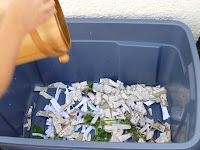
There is almost too much information about composting here. Hennepin County also provides composting tips. There is information all over the internet. The main thing is to get the right combination of green (grass clippings, food scraps, etc) and brown (dead leaves, twigs, paper, cardboard, etc). It is important to turn it and also it should be hot! You can see we started with paper (we add grass clippings, and more paper on top of the food waste) and then mixed it all up. We made sure we set the bin on top of some rocks so the excess moisture could drip out of the bottom. Hopefully all goes well!
According to the EPA:
 Before you decide to cut back on your waste and start composting, check your city laws. In Minneapolis, for example, all compost must be confined for some sort of bin (this could simply be chicken wire) and cannot be within five feet of a property line or within two feet of the alley. As you see in the picture above, Guthrie and I need to move our box over a couple of feet to the left, oops!
Peace!

As you see, I started to drill many (MANY!) holes in it for air flow and for drainage (your compost will stink if you don't!).
During the week, we throw our food scraps in out handy bamboo counter compost bin which you can buy at many kitchen and home stores. We got ours as a wedding gift from Twin Cities Green (now Moss Envy). On their website, I don't see the bamboo version, but the cute ceramic one. Just make sure you buy some extra filters to go along with it. We only empty the container once per week, so extra scraps that don't go into the bin outside (or with the worms, that will come soon!) will sadly have to be thrown away, though we are really trying to cut back on waste. The size of the kitchen counter bin keeps us from adding too much to the bins as they really need to be balanced to be effective (and not stinky!).

There is almost too much information about composting here. Hennepin County also provides composting tips. There is information all over the internet. The main thing is to get the right combination of green (grass clippings, food scraps, etc) and brown (dead leaves, twigs, paper, cardboard, etc). It is important to turn it and also it should be hot! You can see we started with paper (we add grass clippings, and more paper on top of the food waste) and then mixed it all up. We made sure we set the bin on top of some rocks so the excess moisture could drip out of the bottom. Hopefully all goes well!
According to the EPA:
- Over eight percent of the waste that each person generates each day could be recovered for composting. That works out to over 140 pounds per person, per year.
- Yard waste and trimmings account for nearly 13% of municipal solid waste in the United States. This waste consists of grass, leaves, tree, and brush trimmings - adding up to approximately 33 million tons each year.
- Approximately 12% of the municipal solid waste in the United States is food scraps. While it may seem like a small percentage, it equals nearly 32 million tons per year.

Peace!
Sunday, July 11, 2010
Twelve - DIY Bulletin Board
 My desk was getting cluttered and I needed a bulletin board for the office. Though pretty cheap and easy, I didn't want to go buy a new one. It seemed like something I could make myself. With a little help from Google, I saw it -- a Scrabble bulletin board! I got started right away. I ran a bag of donations to the Salvation Army and stopped in to look at their board games. Any game will do, and this is a great project for those board games with missing pieces.
- 1 game board
- any pieces associated with it (Scrabble tiles, Monopoly houses, etc)
- gorilla glue, something equally as strong
- corrugated cardboard (we used the box our Worm Condo came in, post to come!)
- push pins (or thumb tacks)
- super glue
1. Cut out a piece of cardboard a little bit smaller than the size of the game board.

2. Following the gorilla glue instructions carefully, glue cardboard to game board.

3. While waiting for the glue to set, glue game pieces to thumb tacks/push pins. You may have to sand the pieces down first to aid in sticking. I used push pins because I believe the pieces would stay on better if you could push and pull from the pin, not the game piece, though the thumb tacks look a little nicer.
4. Once the board is set (1-2 hours), nail the wall and start hanging!

Peace!
Friday, July 9, 2010
Eleven - Turn Down Your Hot Water Heater

Easy! Saves energy! Saves the environment! Saves money! Saves possible burns! According to the EPA, turning down the thermostat to 120F will save 6-10% of energy costs and slows the mineral buildup and corrosion in your water heater and pipes. Most manufacturers set the thermostat at around 140 degrees, but it is not necessary for the average family. Turn the knob to 120 degrees (low - medium in our case).
 Also, turning down your hot water heater could save you (and more importantly, small children) from terrible burns. The water label on our heater downstairs has time/temperature ratios listed for third degree burns:
1 second at 160F
5 seconds at 140F (and to think that's where most of our hot water heaters are at!)
30 seconds at 130F
5 minutes at 120F
Peace!
Thursday, July 8, 2010
Garden Update!
Here are some pictures of the garden as well as the avocado plant. Remember how small that was? It's a shoot! We have pinched out the top leaves in hopes that will was start to grow out and not so tall! Also, we have some little bitty tomatoes!


Peace!


Peace!
Tuesday, July 6, 2010
Ten - Upcycling the Un-recyclable
Guthrie & I love to recycle! We are very proud of our recycling center, though we are always sad when something that we buy often cannot be recycled. Here are two things we have found another use for.
1. Milk Cartons
 I got the great idea from answers people posted to the question on Re-Nest. First, rinse out completely and then fill with water. Put one or a couple in the freezer and use them as ice blocks in a cooler instead of buying ice from the gas station. Plus, if you rinse them out completely, you can use them as drinking water on road trips or at picnics when the water melts!
We also started using glass milk containers from the co-ops. You pay a bottle deposit, but you essentially pay it once because each time you return it, you get it back (though we usually buy milk every week). The down side is that the milk doesn't stay fresh as long since light can get it and it only comes in half gallon sizes. We will actually use one of the cartons to freeze half of the milk at a time. Usually what we need, when we need, and again, reusing the pesky carton containing. Just make sure you don't fill them all of the way or they will explode in the freezer! When the milk defrosts, give it a shake, and make sure you drink it in a couple of days.
Then we return the glass bottle, get a new, reuse the carton, etc, etc. :-)
 2. Yogurt Containers
(or in this case, a cottage cheese container)
 Planters! These things are hard to recycle, though Stoneyfield Farms is doing great work. I wanted to get some baby spider plants going from our larger one we just acquired thanks to Guthrie's aunt. Poke holes, fill with soil, and plant! We made a mix of dirt from the backyard and worm castings.
Or you just fill up the container (in this case, a jelly jar, on the right) with water, and watch it sprout roots. We'll update you on how they go!

Peace!
1. Milk Cartons

We also started using glass milk containers from the co-ops. You pay a bottle deposit, but you essentially pay it once because each time you return it, you get it back (though we usually buy milk every week). The down side is that the milk doesn't stay fresh as long since light can get it and it only comes in half gallon sizes. We will actually use one of the cartons to freeze half of the milk at a time. Usually what we need, when we need, and again, reusing the pesky carton containing. Just make sure you don't fill them all of the way or they will explode in the freezer! When the milk defrosts, give it a shake, and make sure you drink it in a couple of days.
Then we return the glass bottle, get a new, reuse the carton, etc, etc. :-)
 2. Yogurt Containers
(or in this case, a cottage cheese container)

Or you just fill up the container (in this case, a jelly jar, on the right) with water, and watch it sprout roots. We'll update you on how they go!

Peace!
Monday, July 5, 2010
Check Your Carbon Footprint!
Though it is just a general estimate, it takes just a couple of minutes and is interesting to see. Check out the Carbon Calculator on the left hand side at http://www.nature.org/


Subscribe to:
Posts (Atom)